Getting Started
Before you touch a single pipe or valve, it's important to understand what you're working with. Every community garden irrigation project begins with a few foundational questions:
What is your incoming water pressure? You'll need a basic pressure gauge, which screws onto any standard hose bib or spigot. Take readings at different times of day — especially during peak watering hours — to understand how pressure fluctuates. Typical municipal water pressure ranges from about 40 to 80 PSI (pounds per square inch). Community gardens often experience the lower end of this range, particularly during morning and evening watering rushes.
How many plots will share the system? The more plots drawing from the same source simultaneously, the more carefully you need to plan flow rates and manifold sizing. Even a modest community garden with ten to twenty plots needs a properly sized system to avoid water wars and unhappy gardeners.
What types of irrigation will each plot use? Drip irrigation, soaker hoses, and overhead sprinklers all have different pressure requirements. Drip systems typically operate best between 15 and 30 PSI, while sprinklers may need 30 to 50 PSI or more. Knowing what each gardener intends to use helps you design a system that accommodates everyone.
What is your water source's flow rate? Flow rate, measured in gallons per minute (GPM), tells you how much water is actually moving through your system at any given time. A simple bucket-and-timer test at your main spigot gives you a rough estimate. This number is just as important as pressure, because a high-pressure but low-flow system will still leave gardeners disappointed.
Gathering this information before purchasing any equipment saves time, money, and a great deal of frustration down the road.
Understanding Water Pressure Basics
Water pressure is the force that pushes water through your pipes and out of your irrigation equipment. In a shared system, pressure is a finite resource — the more outlets that are open at once, the less pressure available to each one. This is why understanding how pressure behaves in a shared system is so critical.
Static pressure vs. dynamic pressure are two terms worth knowing. Static pressure is the pressure in your pipes when no water is flowing. Dynamic pressure (also called working pressure) is what you actually measure when water is moving. Dynamic pressure is always lower, and it drops further as more outlets open simultaneously.
Friction loss is another key concept. As water travels through pipes, it loses pressure due to friction against the pipe walls. Longer pipes, smaller pipe diameters, and more fittings all increase friction loss. In a community garden with a central water source and plots spread over a large area, friction loss can be significant enough to cause real problems for plots located far from the source.
To minimize friction loss, use larger diameter supply lines for your main distribution run and only step down to smaller diameter lines at individual plot connections. This keeps pressure losses manageable and ensures more equitable distribution across all plots.
What Is a Manifold and How Does It Work?
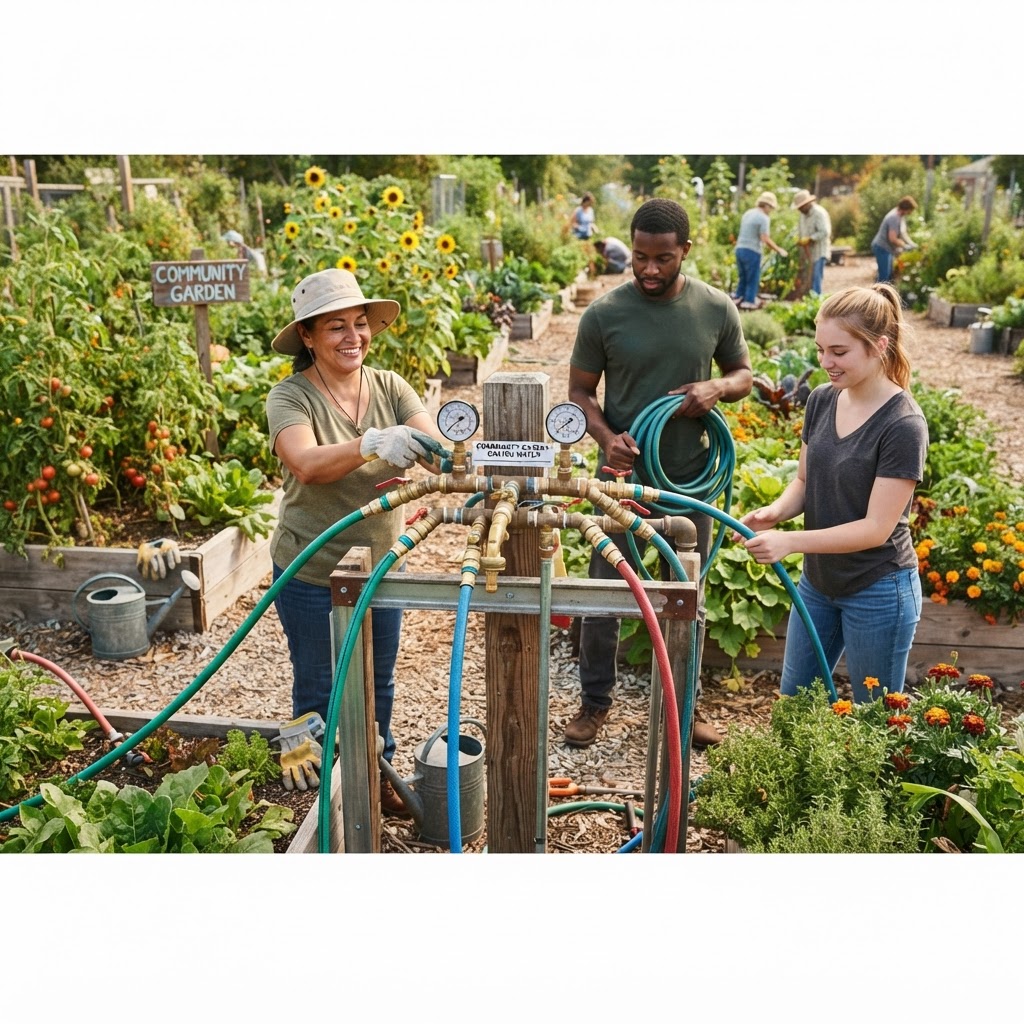
A manifold is essentially a central hub that splits a single water supply line into multiple individual outlets, each of which can be controlled independently. Think of it like a power strip for water — one connection in, multiple controlled connections out.
In a community garden setting, manifolds serve several important purposes:
- Equal distribution: A well-designed manifold delivers similar pressure and flow to each connected line, rather than allowing the first plot in line to take more than its share.
- Independent control: Each outlet on the manifold typically has its own shutoff valve, so individual plots can be turned on or off without affecting others.
- Zoning: Larger gardens may use multiple manifolds to create zones, allowing different areas of the garden to be watered independently or at different times.
Manifolds come in several materials, including PVC, brass, and stainless steel. For most community garden applications, PVC manifolds are affordable and durable enough for the task. Brass manifolds are more robust and better suited to high-pressure situations or permanent installations.
Header manifolds are the most common type in community gardens. They consist of a main supply pipe with multiple outlets branching off at regular intervals. When properly sized, each outlet receives similar pressure regardless of its position along the header.
Zone valve manifolds include automated solenoid valves that can be controlled by an irrigation timer or controller. These are ideal for larger gardens where different zones need to water at different times, reducing the simultaneous demand that causes pressure drops.
Planning Your Manifold Distribution System
Good planning is the difference between a system that works beautifully and one that causes constant headaches. Here's how to approach the design process:
Map Your Garden Layout
Draw a simple map of your garden showing the location of the main water source, all plots, pathways, and any existing infrastructure. Note the distance from the water source to each plot, as this directly affects pipe sizing and pressure calculations.
Calculate Your System's Demands
Add up the flow requirements of all the irrigation equipment that might run simultaneously. If your garden has rules about when plots can be watered (for example, odd-numbered plots water on even days), you may only need to plan for half the plots running at once. If everyone can water whenever they like, plan for a worst-case scenario of most plots running simultaneously.
Size Your Pipes Appropriately
As a general rule, your main supply line should be large enough to handle peak demand without excessive friction loss. A one-inch main supply line serves most small to medium community gardens well. Branch lines serving individual plots can step down to three-quarter inch or half-inch pipe depending on flow requirements.
Choose the Right Manifold Size
Select a manifold with enough outlets to serve all plots in its zone, plus a few extra if your garden is likely to expand. It's much easier to plan for growth now than to retrofit the system later.
Include Pressure Regulators
Installing pressure regulators at key points in the system ensures consistent, safe pressure reaches each plot regardless of fluctuations at the source. A pressure regulator at the main supply connection, combined with regulators at the manifold outlets for drip systems, provides excellent control throughout the system.
Balancing Water Pressure Across Multiple Plots
Achieving truly balanced pressure across all plots requires both good design and occasional adjustment. Here are the key strategies for maintaining balance:
Use a pressure-reducing valve (PRV) at the main connection. This protects your entire system from pressure spikes and provides a stable baseline pressure that your manifold can work from consistently.
Install individual pressure regulators at drip emitter connections. Even with a well-regulated main supply, individual plots benefit from their own pressure regulation, especially those running drip systems.
Consider flow restrictors for plots closest to the source. Plots near the manifold may receive slightly higher pressure than those further away. Flow restrictors — inexpensive inline devices — can limit flow to these plots, creating a more balanced overall system.
Use loop systems for very large gardens. Instead of running a single supply line from one end of the garden to the other, a loop brings the supply line all the way around the garden and connects back to the source. This means every manifold connection receives water from two directions, dramatically improving pressure balance.
Monitor pressure regularly. Seasonal changes, community growth, and equipment wear all affect system pressure over time. Checking pressure at several points in the system a few times per year helps you catch and correct imbalances before they become problems.
Installing and Maintaining Your System
Once your design is complete and your materials are gathered, installation follows a logical sequence:
- Install the main shutoff valve close to the water source so the entire system can be turned off quickly in an emergency.
- Install the pressure-reducing valve downstream of the main shutoff.
- Lay the main supply lines, working from the source outward and securing pipes with appropriate hangers or burial depth to protect from foot traffic and freezing.
- Mount the manifold(s) in accessible locations where gardeners can easily reach shutoff valves for their individual connections.
- Connect branch lines from manifold outlets to individual plots.
- Install individual plot connections, including plot-level shutoff valves, pressure regulators (for drip systems), and backflow preventers where required.
- Flush the system thoroughly before connecting any emitters or sprinkler heads, to clear debris from installation.
- Test and adjust pressure at multiple points throughout the system.
Ongoing maintenance keeps the system performing well season after season. Flush manifolds and filters at the start of each season, check all connections for leaks, replace worn washers and O-rings, and winterize the system before freezing temperatures arrive by draining all lines and manifolds.
Common Mistakes to Avoid
Even experienced gardeners make these errors when setting up shared irrigation systems. Knowing them in advance keeps your project on track.
Ignoring peak demand times. Designing a system around ideal conditions rather than peak use leads to chronic pressure problems. Always design for the busiest watering period you can realistically anticipate.
Using undersized main supply lines. This is one of the most common and most costly mistakes. A half-inch main supply line might seem adequate for a few plots, but it creates massive friction loss in any meaningful garden. Size up generously on your main line.
Skipping backflow preventers. Backflow preventers stop contaminated water from siphoning back into the municipal supply. Many local codes require them, and they protect both your garden and your neighbors' drinking water. Never skip this component.
Connecting too many plots to a single manifold zone without accounting for flow. Overloading a single manifold zone means that when everyone waters at once, nobody gets adequate pressure. Zone your system appropriately and consider staggered watering schedules for large gardens.
Forgetting to account for elevation changes. If your garden is on a slope, plots at lower elevations receive higher pressure than those at higher elevations. This can cause over-pressurization at lower plots and underperformance at higher ones. Use pressure regulators to compensate.
Neglecting regular maintenance. A manifold system left unchecked will gradually degrade. Mineral buildup clogs emitters and regulators, UV exposure degrades plastic fittings, and small leaks become big ones. Schedule regular check-ins.
Tips for Success
- Start with a water audit. Before making any changes to an existing system, document current pressure and flow at every connection point. This baseline helps you measure improvements accurately.
- Involve your community in the planning process. Understanding what each gardener needs and expects from the irrigation system leads to better design decisions and more buy-in when the system is complete.
- Label every valve clearly. In a manifold with a dozen outlets, unlabeled valves lead to confusion and accidental shutdowns. Use waterproof labels or valve tags for every connection.
- Create a simple operating guide for members, explaining how to use the system, what their individual plot connection allows, and who to contact if they notice a problem.
- Build in redundancy where possible. A single point of failure can take your entire garden's water offline. Consider installing a bypass valve around critical components so the system can keep running while repairs are made.
- Set up a watering schedule if demand is high. Organized watering times dramatically reduce peak demand and prevent pressure complaints. Even a simple odd/even day schedule can make a noticeable difference.
- Use quality fittings at critical connections. It's tempting to save money on fittings, but low-quality connectors at your manifold and main supply line junctions are the most likely points of failure. Invest in reliable brass or high-grade PVC fittings at these locations.
Conclusion
Managing shared water pressure and manifold distribution in a community garden is part engineering, part community coordination, and part ongoing stewardship. The good news is that with a solid understanding of water pressure principles, a thoughtfully designed manifold system, and a commitment to regular maintenance, shared irrigation can work beautifully for every plot in your garden.
The key takeaways are simple: know your water source, design for peak demand, use appropriate pipe sizes, regulate pressure throughout the system, and keep your community informed and involved. A garden where every member feels their plants are getting what they need is a garden that thrives — not just in produce, but in the spirit of community that makes these spaces so special.
Whether you're setting up a brand new system or troubleshooting an existing one, return to the fundamentals covered in this guide and you'll have the tools to solve most challenges that come your way.